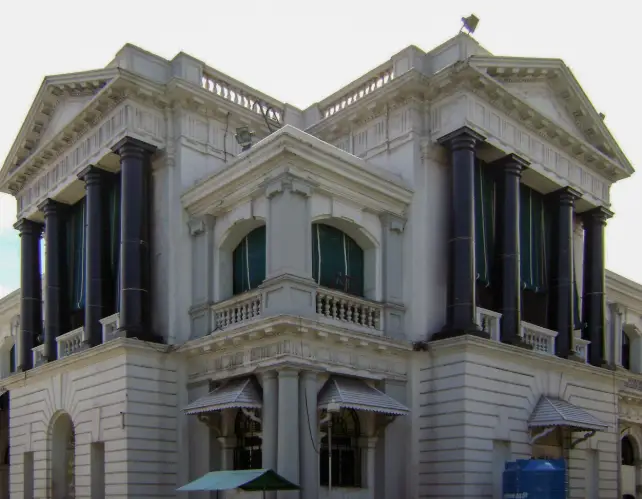
The Fort St. George Museum in Chennai, Tamil Nadu, is a government-run heritage museum housed within Fort St. George—India’s first British fortress. Established in 1948, it preserves and interprets colonial-era artifacts reflecting the city’s transformation from the East India Company’s trading hub to a modern capital. Its collection makes it a key site for understanding the British Raj’s administrative and cultural imprint on South India.
Historical background
Built in 1644 by the British East India Company, Fort St. George was the first English fortification in India. The museum occupies the 18th-century Exchange Hall, where early colonial trade and governance took shape. It is now managed by the Archaeological Survey of India and stands within the working Tamil Nadu Secretariat complex.
Collections and galleries
The museum spans three floors with ten galleries showcasing over 3, 000 items: British and Indian weaponry, uniforms, medals from the Carnatic and Anglo-Mysore Wars, portraits of rulers and governors, and correspondence from figures such as Robert Clive and Lord Cornwallis. Visitors also see porcelain ware, Indo-French clocks, colonial coins, and the first Indian national flag hoisted in Chennai after independence.
Architecture and highlights
The neoclassical building features arched corridors and high ceilings typical of late-Georgian design. At the entrance stands a marble statue of Lord Cornwallis—an enduring emblem of British administration. Within the same compound lies St. Mary's Church, the oldest Anglican church in India, adding to the site’s layered colonial heritage.
Visitor information
Located on Rajaji Road near the Secretariat, the museum is open 9 a.m.–5 p.m. daily except Friday. Admission is ₹20 for Indian citizens and ₹250 for foreign visitors. Photography inside is restricted, and access requires routine security checks as it lies within a government zone.
The Fort St. George Museum remains one of Chennai’s foremost historical attractions, offering an immersive view into the city’s colonial past and its enduring architectural legacy.